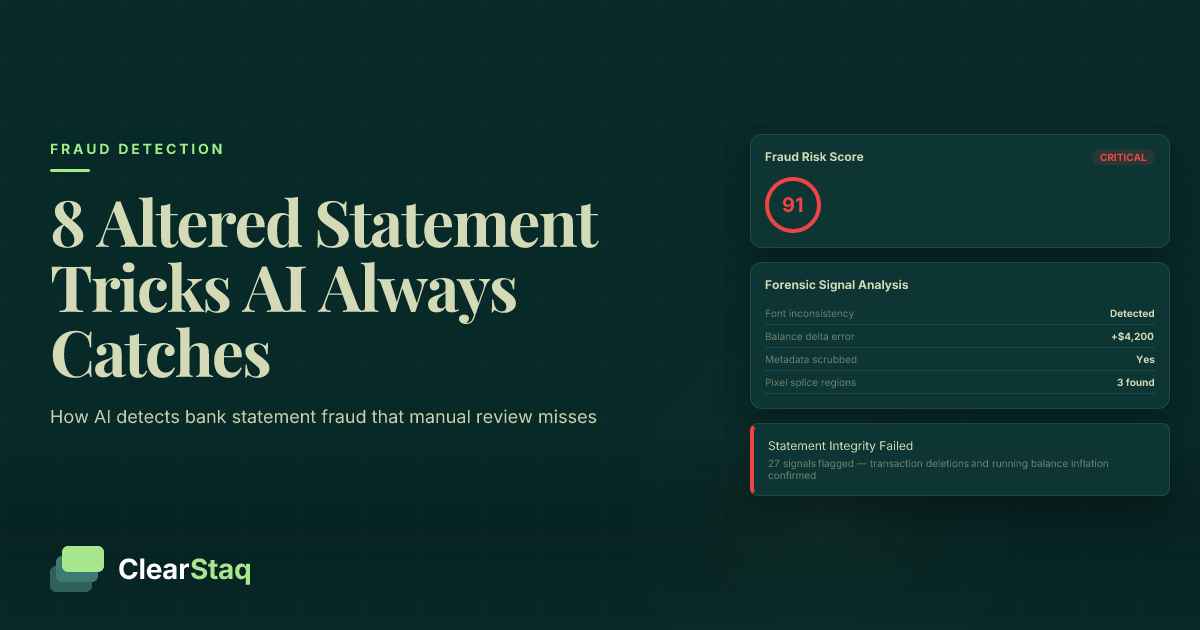
Altered bank statements evade manual review through eight techniques: direct text layer editing, image pixel splicing, template cloning, selective transaction deletion, running balance inflation, PDF metadata scrubbing, font injection, and revenue smoothing. AI-based detection systems flag all eight by analyzing 27 forensic signals — including font embedding anomalies, metadata timestamps, and statistical deposit pattern irregularities — in under three seconds.
What you'll learn
- Eight distinct alteration techniques exploit the gap between what human reviewers can check visually and what forensic AI analysis can detect computationally
- PDF metadata — including creation date, modification date, and creator software fingerprint — reveals document tampering even when visual output looks perfect
- Revenue smoothing is the most sophisticated technique and the one most likely to defeat manual review entirely, because it removes irregularities rather than creating them
- AI performs full transaction-level balance reconciliation across every page and every month in under three seconds — a check that is computationally impossible for manual reviewers at scale
- Submitting an altered bank statement for a loan application constitutes bank fraud under 18 U.S.C. § 1344, carrying penalties of up to 30 years imprisonment and $1 million in fines
Altered bank statements typically evade manual review through eight techniques: direct text layer editing, image pixel splicing, template cloning, selective transaction deletion, running balance inflation, PDF metadata scrubbing, font injection, and revenue smoothing. AI-based detection systems flag all eight by analyzing 27 forensic signals simultaneously — including font embedding anomalies, metadata timestamps, and statistical deposit pattern irregularities — in under three seconds.
Why Altered Bank Statements Keep Slipping Through Manual Review
Bank statement fraud is not a niche problem. According to our 2026 bank statement fraud data, document manipulation now accounts for a significant share of application fraud losses across the lending industry. The FBI's Internet Crime Complaint Center and the ACFE both consistently rank document fraud among the highest-impact financial crime categories — with losses measured in the billions annually.
Yet lenders keep funding fraudulent applications. The reason isn't a lack of diligence. It's a structural mismatch between what human reviewers can check and what modern fraud techniques exploit.
A trained underwriter reviewing a bank statement checks 10 to 15 signals at most — and nearly all of them are visual. AI simultaneously evaluates 27 signals across four detection layers, including signals that are computationally impossible to replicate manually. The gap between those two numbers is where all eight alteration techniques live.
Fraud tooling has also evolved. In 2025 and 2026, AI-assisted document editing tools make alterations significantly harder to detect on screen. What once required a skilled graphic designer can now be accomplished by any motivated applicant with a $20 software subscription.
The Human Reviewer's Blind Spots
Manual reviewers realistically check for: obvious font inconsistencies, suspicious round-number deposits, formatting irregularities, and whether the statement looks like a known bank's template. These are all valid signals — but they're also the signals that fraudsters have known about and worked around for years.
The signals that actually catch modern alterations require computation: character spacing delta measured to fractions of a point, PDF object stream comparison, cryptographic hash validation, and statistical deposit distribution analysis. No human reviewer can perform these checks manually on a 12-month statement package in a reasonable timeframe.
The fraudster's advantage is knowing exactly which signals manual reviewers can and can't check. Every technique on this list is designed to exploit that knowledge.
Native PDFs vs. Scanned Statements: Why the Distinction Matters
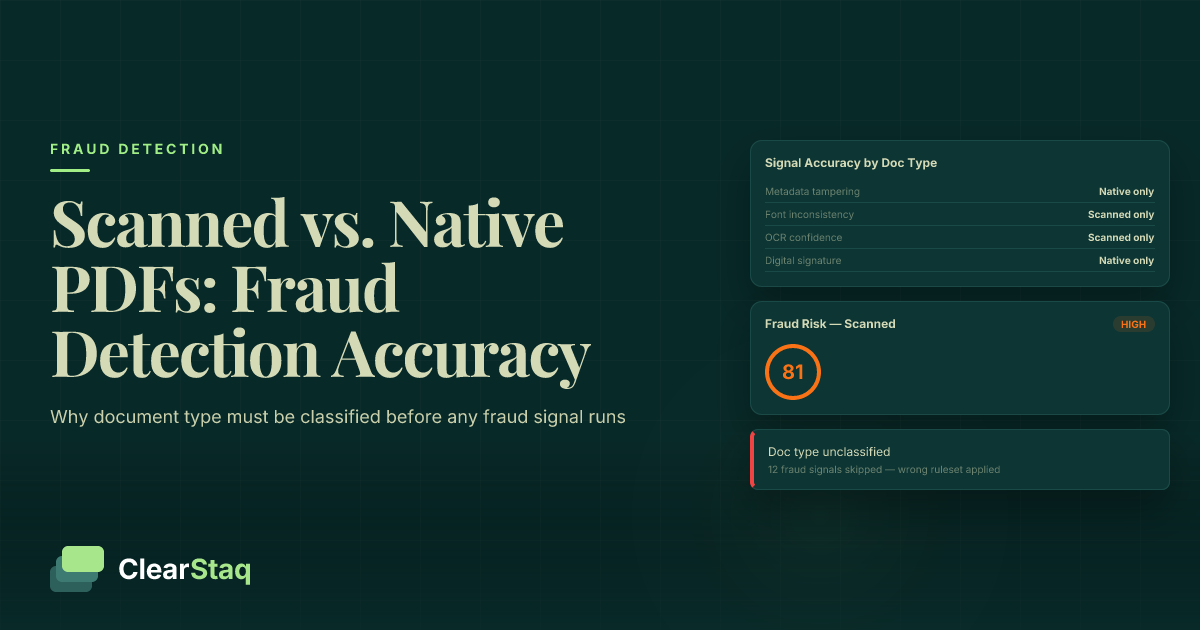
Before mapping each technique to its detection signal, one foundational distinction matters: the difference between scanned vs. native PDF bank statements.
A native PDF is digitally generated by the bank's output management system. It contains a text layer, embedded fonts, structural metadata, and object streams. This type is susceptible to text layer editing, metadata scrubbing, and font injection.
A scanned statement is a photograph or scan of a paper document. It's essentially a flat image — no text layer, no editable metadata. This type is susceptible to pixel-level image manipulation and splice artifacts.
AI must classify the document type first before routing it to the appropriate detection pipeline. The wrong pipeline applied to the wrong document type produces false negatives. Getting the classification right is step zero.
Technique #1: Direct Text Layer Editing in Native PDFs
This is the most common bank statement manipulation method for digitally native documents. Using widely available PDF editors — Adobe Acrobat, PDF-XChange, Foxit — a fraudster selects text directly in the document's text layer and overwrites it. Deposit amounts become larger. NSF fees disappear. Running balances adjust.
The visual output is nearly indistinguishable from the original. The layout is unchanged. The table structure is intact. A reviewer scanning the document on screen sees exactly what the fraudster intended.
In the MCA context, the most common use case is inflating daily deposit amounts to push the average daily balance above a lender's minimum threshold — the single number most underwriters check first.
The Forensic Signal: Font Embedding Mismatch
Banks render statements using proprietary typesetting pipelines. The fonts used aren't just "Arial" or "Helvetica" — they're specific embedded font subsets, generated by the bank's print system, with unique hinting data, kerning tables, and glyph metrics baked into the PDF at generation time.
When a fraudster overwrites text, the replacement characters are rendered in whatever font the PDF editor uses — even if the fraudster manually selects the "correct" font family. The font version, optical sizing, and kerning table almost never match exactly.
AI compares the glyph metrics and font descriptor of every character in the document against the expected embedded font profile for that bank. A single character with mismatched metrics in a field containing a modified number is enough to flag the document.
How AI Detects It in Under 3 Seconds
The detection process runs in parallel across four operations:
- PDF parser extracts all font objects and compares them against a library of known bank font profiles — ClearStaq supports 900+ bank formats
- Character spacing analysis flags delta values outside the tolerance range for that bank's specific template
- Object stream diff identifies pages where new content streams were appended after the original document was generated
- Each signal fires with a confidence score and a specific page and field location
The result is a fraud signal log that tells a reviewer not just that the document was altered, but where — down to the specific cell in a specific table on a specific page.
Technique #2: Image Splicing and Pixel Manipulation on Scanned Statements
For scanned statements, the text layer editing approach doesn't work — there's no text layer to edit. Instead, fraudsters treat the document as an image and use image editing software to cut, paste, and overwrite specific regions.
Common targets are deposit amounts, transaction descriptions, running balances, and sometimes account numbers. The fraudster opens the scanned image in Photoshop or GIMP, selects a region, and replaces the content with fabricated numbers or text rendered in a matching font.
At low resolution — the kind produced by a digital fax or a smartphone photo — pixel-level artifacts are nearly invisible on screen. Manual reviewers don't look at individual pixels. They look at numbers. And the numbers look right.
Pixel-Level Artifacts That Betray Image Editing
Three artifact types reliably expose image manipulation:
- JPEG compression history: Every time a JPEG image is saved, compression artifacts accumulate in a predictable pattern. A region spliced in from a different source image has a different compression history — detectable by analyzing the artifact distribution across the document surface.
- Clone stamp residue: Fraudsters frequently use clone stamp tools to fill in backgrounds before pasting new content. This creates repetitive pixel patterns in the noise layer that don't appear in legitimately scanned documents.
- Edge sharpness discontinuity: Digital text pasted over a scanned background has sharper edge gradients than the surrounding scan grain. The transition between pasted region and original scan is mathematically detectable even when it's invisible to the human eye.
Why Low-Quality Scans Are Not a Safe Harbor
Some fraudsters deliberately degrade image quality — adding JPEG compression, reducing resolution — to obscure manipulation artifacts. This doesn't work.
AI applies noise normalization before artifact analysis. Degradation that is uniform across the document is expected; degradation that is non-uniform — concentrated in specific regions — is itself a manipulation signal. A document where one column of numbers is slightly blurrier than the surrounding text is more suspicious, not less.
Statistical analysis of pixel variance across the document surface flags regions with anomalous noise profiles, regardless of the overall image quality.
Technique #3: Template Cloning from Real Bank Formats
This technique doesn't start with a real statement at all. Fraudsters download or purchase accurate replicas of bank statement templates from dark web marketplaces, then populate them with entirely fabricated transaction data.
The quality of these templates has improved dramatically. Logos, fonts, layouts, watermarks, and even security patterns are accurately reproduced. A reviewer who isn't intimately familiar with the subtle formatting details of a specific bank's current statement design cannot reliably spot the difference.
The Dark Web Template Marketplace
Templates for Chase, Wells Fargo, Bank of America, and other major institutions are commercially available. Entry-level templates start under $100. More sophisticated auto-fill kits — which include editable fields and macros for populating transaction data — are available for $500 to $2,000. Some vendors offer "verified" templates updated after banks refresh their statement designs.
This commoditization has a critical implication: fraud is no longer limited to technically sophisticated actors. Any applicant with a few hundred dollars and a dark web account can purchase and populate a convincing fake statement. The skill barrier has collapsed.
How ClearStaq's Format Library Catches Cloned Templates
ClearStaq's 900+ bank format profiles include the expected position of every field, font specifications, margin widths, column dimensions, and table grid parameters for each institution. Cloned templates rarely replicate all structural details perfectly — slight variations in column widths, header positioning, or footer content expose the fraud.
Beyond layout, bank-generated PDFs contain structural metadata — producer software, creator application, encryption flag configuration — that a cloned template cannot reliably reproduce. This metadata is checked as part of the 27 fraud detection signals evaluated on every document.
As the visualization above shows, template cloning rarely produces a single clean flag — it produces multiple simultaneous signals across font, metadata, and structural layers. Those signals are weighted and combined into a single fraud score, giving underwriters an actionable confidence metric rather than a list of technical anomalies to interpret.
Technique #4: Selective Transaction Deletion to Hide Negative Patterns
Rather than adding fake transactions, this technique removes real ones. The targets are specific: NSF fees, MCA payment deductions, overdraft events, and returned ACH items — exactly the transaction types that signal cash flow stress to an underwriter.
When the remaining transactions are renumbered and the running balance is adjusted to compensate, no visual gap appears. A reviewer scanning for red flags doesn't see them — because they've been surgically removed.
This is one of the most MCA-specific techniques on this list. The most common deletion targets are existing MCA deductions (to hide stacking), NSF fees (to hide cash flow fragility), and returned ACH items (to hide payment failures). Understanding NSF frequency patterns is essential context for evaluating why their absence is suspicious.
NSF Deletion: The MCA Underwriter's Blind Spot
NSF fees are the single most commonly deleted transaction type in MCA fraud. Here's the problem: a statement with zero NSF fees over six months for a high-volume retail business is a statistical anomaly, not a positive signal.
Real businesses — especially small to medium merchants — occasionally overdraw accounts, miss timing on deposits, or have returned items. A statement that shows none of these events over an extended period isn't a sign of excellent financial management. It's a sign that something was removed.
AI cross-references NSF frequency against industry benchmarks for the merchant's declared business type and revenue volume. Too few NSF events is flagged just as readily as too many.
Balance Reconciliation: The Math That Catches Deletions
Every legitimate bank statement satisfies a simple equation: opening balance + sum of all credits − sum of all debits = closing balance. When transactions are deleted and the fraudster fails to adjust balances accordingly, this equation breaks immediately.
When the fraudster does adjust balances, a second check catches it: the adjusted closing balance creates a discontinuity with the prior month's statement closing balance — or with the opening balance on the next page of a multi-page statement.
AI performs this reconciliation across every transaction, every page, and every month in the submitted statement package. For a human reviewer, checking hundreds of running balance entries is practically impossible. For AI, it takes milliseconds.
For a broader look at the visual and computational signs of statement tampering, see our guide to signs of a fake bank statement.
Technique #5: Balance Inflation by Modifying Running Totals
Instead of adding fake deposits, some fraudsters edit the running balance column directly — inflating ending balances to meet a lender's minimum balance requirement without adding transactions that might raise statistical flags.
This technique reflects a degree of sophistication: the fraudster knows that large round-number deposits attract attention, so they avoid creating them. Editing a single number in the balance column seems like a smaller change with less exposure.
Manual reviewers typically verify the opening and closing balance for the statement period and spot-check a few intermediate entries. A fraudster who edits only the closing balance — the most common approach — sails through a spot-check every time.
Why Spot-Checking Fails to Catch Balance Edits
Full transaction-level reconciliation requires checking every running balance entry against the cumulative sum of all prior transactions. For a three-month statement with 200+ transactions, this means verifying 200+ arithmetic operations.
Computationally trivial for AI. Practically impossible for a manual reviewer under time pressure. This is precisely why the technique persists — it's specifically calibrated to the limitations of human review.
The Cross-Page Continuity Signal
Multi-page bank statements must show the closing balance of one page matching the opening balance of the next. It sounds simple, but fraudsters who edit balances on page 3 frequently forget to propagate the change to the opening balance displayed on page 4.
AI performs this check across every page boundary in multi-page statements and across all months in a submitted package. A single page-boundary mismatch generates an immediate fraud signal — one that requires zero visual inspection to catch.
See ClearStaq's Fraud Detection in Action
Upload a bank statement and get instant fraud analysis across all 27 detection signals — font fingerprinting, metadata validation, balance reconciliation, and statistical pattern analysis included. Start your free trial — no credit card required.
Technique #6: PDF Metadata Scrubbing and Timestamp Spoofing
Every PDF contains metadata fields invisible to the reader but accessible to anyone who inspects the file structure: creation date, modification date, creator software name, producer application, and unique document identifiers. This metadata is the document's fingerprint.
A legitimate bank statement PDF is generated once, by the bank's output management system, overnight. The creation date equals the statement generation date. The modification date is absent or identical to the creation date. The creator software is the bank's known system — not Adobe Acrobat, not LibreOffice.
When a fraudster edits the document, any competent PDF editor logs a modification. Sophisticated fraudsters use metadata scrubbing tools to remove or overwrite these fields before submission. For a complete technical breakdown of what this looks like, see our deep-dive on PDF metadata analysis as a fraud signal.
What Legitimate Bank PDF Metadata Looks Like
A clean, unaltered bank statement PDF contains:
- Creation date matching the statement generation date, typically reflecting overnight batch processing
- Creator field showing the bank's known PDF generation software — a specific version of an enterprise output management system consistent across all statements from that institution
- Producer field showing the PDF library used by the bank's system — consistent across all statements from that bank
- Modification date absent or identical to creation date
- Document ID — a system-generated hash unique to that specific statement instance
Deviation from any of these patterns is a fraud signal. The specific combination of deviations often reveals not just that a document was altered, but which tool was used to alter it.
How Fraudsters Attempt to Spoof Metadata
Three common spoofing approaches — and why they all fail:
- Full scrubbing: Removing all metadata fields eliminates the evidence of modification. But completely blank metadata is itself a fraud signal — legitimate bank PDFs always contain creator and producer data. A document with no metadata is more suspicious than one with modified metadata.
- Date setting: Some fraudsters set the creation date to match the statement period end date. The software fingerprint still reveals non-bank origin — the creator field shows a consumer PDF editor, not the bank's enterprise system.
- Metadata cloning: Advanced fraudsters clone metadata from a legitimate statement sample. But the document ID hash no longer matches the document content, creating a detectable cryptographic inconsistency.
Technique #7: Font and Spacing Injection to Mimic Bank Typography
This technique is the fraudster's response to getting caught on font mismatches. Knowing that font embedding anomalies are a detection signal, more sophisticated actors attempt to match the bank's exact font — embedding the correct font family and size — before inserting altered text.
It's the most technically demanding approach on this list. It also still fails.
Why "Matching the Font" Is Not Enough
Font families contain hundreds of variants — weight, optical sizing, hinting configuration — that must all align exactly. Banks apply proprietary kerning tables during PDF generation that are not publicly available and cannot be reverse-engineered from the document alone.
Even a visually perfect match contains detectable differences at the glyph metric level:
- Character spacing delta: Bank typesetting engines apply micro-level kerning adjustments that PDF editors don't replicate. The inter-character spacing in an injected text run differs from adjacent bank-generated text by measurable fractions of a point.
- Glyph substitution: PDF editors may use a different glyph variant for certain characters — detectable by comparing the bezier curve definitions of identical characters across the document.
- Line-height inconsistency: Injected text rows frequently have slightly different line heights than adjacent rows generated by the bank's typesetting system.
AI-Assisted Fraud: The New Frontier in 2025–2026
Generative AI tools can now produce more convincing font and layout matching than manual editing ever could. This is a growing vector that competitor content from 2022 and 2023 doesn't address at all — the threat landscape has changed significantly.
AI-generated visual alterations are harder to catch at the pixel level. But they still leave statistical signatures in deposit pattern data and balance reconciliation math that are entirely independent of how the document looks. A perfectly rendered fake statement with statistically implausible revenue patterns will still fail the fraud score.
ClearStaq's detection layer weights non-visual signals more heavily in response — ensuring that improvements in visual fraud quality don't reduce overall detection accuracy. For more on how AI spots altered PDFs even when visual signals are clean, the technical breakdown covers the full detection logic.
Technique #8: Revenue Smoothing — Artificially Normalizing Deposit Patterns
This is the most sophisticated technique on this list — and the one that most reliably defeats manual review entirely.
Rather than fabricating large deposits that stand out, the fraudster subtly adjusts many small deposit amounts to eliminate variance. The result is an artificially consistent revenue pattern: deposits arrive regularly, amounts cluster tightly around a mean, and the account shows steady, predictable income month after month.
To a human reviewer trained to look for irregularities, this statement looks better than it should. There are no red flags because the technique's entire purpose is to remove them. This specific vector — known as artificial cash flow smoothing — is almost entirely absent from competitor coverage, which means underwriters relying on conventional guidance have no framework for recognizing it.
What Real Business Revenue Looks Like Statistically
Real business revenue is not smooth. It is variable in predictable ways:
- Retail businesses show weekly cyclicality — higher deposit volumes Monday and Tuesday from weekend sales activity, lower mid-week
- Seasonal businesses show monthly and quarterly variance that matches industry benchmarks for their category
- SaaS businesses with recurring revenue show occasional spikes, delayed payments, partial refunds, and annual contract bumps
- All businesses occasionally have slow weeks, returned checks, bank fees, and other negative events
The statistical measure AI uses to catch smoothing is the coefficient of variation — the ratio of standard deviation to mean for deposit amounts over the statement period. Real businesses fall within a predictable range for their declared revenue volume and industry. Artificially smoothed statements fall well below that range. Too-low variance is just as suspicious as too-high variance.
MCA-Specific Context: Smoothing Before Position Detection
In the MCA context, revenue smoothing serves a specific tactical purpose: hiding existing MCA payment deductions. By slightly increasing deposit amounts to offset the regular ACH debits from an existing MCA position, the net daily balance appears healthy to a new lender's underwriting system.
This technique is specifically designed to defeat position detection logic. ClearStaq's MCA position detection cross-references deposit smoothing anomalies against known MCA payment timing patterns — catching statements where the deposits have been adjusted precisely to offset the withdrawal schedule of an undisclosed MCA position.
The heatmap above shows how deposit pattern variance is mapped across weeks and months. Notice how legitimate business revenue produces visible variance clusters — the signal of real operating activity. A revenue-smoothed statement produces an unnaturally uniform heat distribution that the AI flags immediately.
How AI Flags All 8 Techniques: The Signal-Layer Approach
Each of the eight techniques exploits a different vulnerability. Catching all of them requires a detection architecture organized into four parallel layers, each targeting a different class of forensic signal.
Document type classification runs first — native PDF vs. scanned image — routing the document to the appropriate detection pipeline. Then all four layers run simultaneously:
- Layer 1 — Structural signals: Font analysis, metadata validation, PDF object structure comparison. Catches Techniques 1, 6, and 7.
- Layer 2 — Pixel-level signals: Image artifact analysis, compression history, noise variance mapping. Catches Technique 2.
- Layer 3 — Data integrity signals: Balance reconciliation, transaction ID sequence validation, cross-page continuity. Catches Techniques 4 and 5.
- Layer 4 — Statistical signals: Deposit pattern distribution, coefficient of variation, day-of-week cyclicality, NSF frequency benchmarking. Catches Techniques 3 and 8.
All layers run in parallel. Total processing time: under three seconds.
The alert feed above shows individual fraud signals firing across detection layers as the AI processes a document in real time. Each signal carries a confidence score and a specific location reference — giving reviewers a precise, actionable fraud log rather than a binary pass/fail result.
27 Signals vs. 10–15 Manual Checks: The Detection Gap
A trained underwriter performing a thorough manual review checks approximately 10 to 15 signals. Every one of them is visual — fonts, formatting, round numbers, template consistency.
ClearStaq's 27 fraud detection signals span all four detection layers, including signals that are computationally impossible to check manually: metadata timestamp validation, balance reconciliation across hundreds of transactions, glyph-level character spacing analysis, and statistical deposit variance scoring.
The signals that matter most for catching modern altered bank statements are precisely the ones manual review can't cover. This isn't a criticism of underwriters — it's a description of what computation makes possible that human attention cannot.
The Role of the 900+ Bank Format Library
Every detection layer is calibrated to the specific bank's known format profile. What counts as an anomalous column width for a Chase statement differs from what counts as anomalous for a regional credit union. Format-specific calibration dramatically reduces false positives — the system knows what legitimate variance looks like for each institution.
ClearStaq's format library currently covers 900+ bank and credit union formats, expanding continuously as new statement types are processed. For how AI spots altered PDFs across this breadth of formats, the underlying detection logic is consistent even as the calibration parameters vary by institution.
Manual Review vs. AI Detection: A Side-by-Side Comparison
The difference between manual review and AI detection isn't just speed — it's coverage. Here's how the two approaches compare across every signal category relevant to altered bank statement detection:
| Signal Category | Manual Review | AI Detection (ClearStaq) |
|---|---|---|
| Font consistency | Visual check only — gross mismatches caught, subtle embedding differences missed | Glyph metric comparison against bank font profile — sub-point spacing delta detected |
| PDF metadata inspection | Not visible in standard document viewers — effectively unchecked | Full metadata extraction and validation against known bank system fingerprints |
| Pixel artifact detection | Not possible — human eyes cannot detect JPEG compression history | Compression artifact analysis, clone stamp detection, edge gradient mapping |
| Balance reconciliation | Spot-check of opening and closing balance only | Transaction-level reconciliation across all entries, all pages, all months |
| Transaction sequence validation | Manually checking ID sequences is impractical at volume | Automated sequence gap detection across full transaction history |
| Statistical pattern analysis | Not feasible — requires statistical modeling across hundreds of data points | Coefficient of variation, day-of-week cyclicality, NSF frequency benchmarking |
| Format conformity checking | Relies on reviewer familiarity with each bank's template | Automated comparison against 900+ bank format profiles |
| Processing time per file | 20–45 minutes for a 3-month statement package | Under 3 seconds |
| Files processed per day | 10–15 under careful review | Thousands per hour via API |
Manual review isn't without value. Experienced underwriters bring contextual judgment that AI can't replicate — cross-referencing document signals against applicant behavior, business narrative, and industry knowledge. The recommendation isn't to eliminate manual review. It's to use AI for automated bank statement fraud indicators screening at scale, and reserve human judgment for the borderline cases AI flags for final decision.
For a complete list of the fraud red flags AI catches that manual review misses, the companion guide covers each signal category in practical terms for lending teams.
The Legal and Compliance Dimension
Submitting an altered bank statement for a loan application constitutes bank fraud under 18 U.S.C. § 1344 — with penalties up to 30 years imprisonment and $1 million in fines. That's the applicant's exposure. But lenders carry regulatory exposure too.
For MCA lenders: funding based on altered statements creates potential BSA/AML reporting obligations and regulatory audit risk. The FDIC and federal banking regulators increasingly expect documented fraud screening procedures — not just manual reviews with no audit trail.
Automated fraud detection creates that audit trail. AI detection logs document every signal evaluated, every confidence score assigned, and every flag generated — admissible evidence of systematic due diligence if an advance becomes the subject of a fraud investigation or regulatory inquiry.
Lenders relying solely on manual review without documented AI-assisted screening are increasingly exposed in regulatory audits. The procedural question is no longer just "did you check?" — it's "what did you check, and how thoroughly?"
Building a Scalable Detection Workflow
Integrating AI fraud detection into an underwriting workflow doesn't require replacing existing processes. It restructures them:
- Ingest: All submitted bank statements enter via API — no manual sorting or routing required
- Analyze: AI classifies document type, runs all 27 fraud signals, returns a fraud score with complete flag breakdown in under three seconds
- Route: Low-risk files proceed automatically; high-risk files route to the manual review queue with specific flags highlighted
- Review: Manual reviewers focus only on flagged files — review time drops from 45 minutes to 5–10 minutes per file because the AI has already identified exactly what to examine
The outcome: fraud detection coverage increases across 100% of submitted documents, while total manual review hours decrease. Underwriters spend less time on clean files and more time on the cases where their judgment actually matters.
Frequently Asked Questions
How do fraudsters alter bank statements without detection?
Fraudsters exploit the gap between what manual reviewers can check visually and what actually reveals document manipulation. The most effective techniques — revenue smoothing, metadata scrubbing, and balance column editing — produce statements that look clean on screen but fail forensic AI analysis. Automated altered bank statement detection closes this gap by evaluating signals that are impossible to check manually.
Can AI detect fake bank statements?
Yes. AI-powered document fraud detection systems analyze font embedding profiles, PDF metadata timestamps, pixel-level artifact patterns, balance reconciliation math, and statistical deposit distributions simultaneously. ClearStaq's system evaluates 27 forensic signals and returns a fraud score with individual signal flags in under three seconds — catching alterations that have no visible indicators whatsoever.
What are the most common signs of an altered bank statement?
The most reliable signs aren't visual — they're computational. Font embedding mismatches, modification timestamps in PDF metadata, balance reconciliation failures across pages, transaction ID sequence gaps, and statistically anomalous deposit distributions are the primary bank statement fraud indicators that AI detects. Visual signs like font inconsistencies and round-number deposits are real but are increasingly avoided by sophisticated fraudsters.
What is PDF metadata and how does it reveal fraud?
PDF metadata is a set of hidden fields embedded in every PDF file — including creation date, modification date, creator software name, and a unique document ID. A legitimate bank statement is generated once by the bank's system and never modified. When a fraudster edits the document, the modification date updates, the creator software changes to a consumer PDF editor, and the document ID no longer matches the content. PDF bank statement forgery is often exposed by metadata alone, even when the visual output is perfect.
What happens if you submit a fake bank statement for a loan?
Submitting an altered bank statement for a loan application constitutes bank fraud under federal law (18 U.S.C. § 1344), carrying penalties of up to 30 years imprisonment and fines up to $1 million. Lenders who detect fraudulent submissions are required to document the finding and may have BSA/AML reporting obligations. Automated fraud detection systems create an audit trail that supports both prosecution of the applicant and regulatory defense for the lender.
How accurate is automated bank statement fraud detection?
AI-based bank statement verification software operating on 27+ forensic signals achieves significantly higher detection rates than manual review across all eight major alteration techniques. ClearStaq's system processes documents with format-specific calibration across 900+ bank profiles, which reduces false positives while maintaining high sensitivity to genuine manipulation signals. The combination of structural, pixel-level, data integrity, and statistical signals catches techniques that produce no visual artifacts at all.
Ready to Automate Altered Bank Statement Detection?
Stop funding decisions on statements you can't fully verify. ClearStaq's fraud detection engine evaluates 27 forensic signals across every document you receive — in under three seconds, at any volume. Start your free trial today and see exactly what manual review has been missing.
Frequently Asked Questions
How do fraudsters alter bank statements without detection?
Fraudsters exploit the gap between what manual reviewers can check visually and what forensic analysis actually reveals. The most effective techniques — revenue smoothing, PDF metadata scrubbing, and running balance column editing — produce statements that look clean on screen but fail automated altered bank statement detection when AI evaluates font embedding profiles, metadata timestamps, and statistical deposit distributions simultaneously.
Can AI detect fake bank statements?
Yes. AI-powered document fraud detection systems analyze font embedding profiles, PDF metadata timestamps, pixel-level artifact patterns, balance reconciliation math, and statistical deposit distributions in parallel. ClearStaq's system evaluates 27 forensic signals and returns a fraud score with individual signal flags in under three seconds — catching alterations that produce no visible indicators whatsoever.
What are the most common signs of an altered bank statement?
The most reliable bank statement fraud indicators are computational, not visual: font embedding mismatches, modification timestamps in PDF metadata, balance reconciliation failures across pages, transaction ID sequence gaps, and statistically anomalous deposit distributions. Visual signs like font inconsistencies and round-number deposits are real but are increasingly avoided by sophisticated fraudsters using modern editing tools.
What is PDF metadata and how does it reveal fraud?
PDF metadata is a set of hidden fields embedded in every PDF file — including creation date, modification date, creator software name, and a unique document ID. A legitimate bank statement is generated once by the bank's system and never modified; when a fraudster edits the document, the modification date updates and the creator software changes to a consumer PDF editor, exposing PDF bank statement forgery even when the visual output is perfect.
What happens if you submit a fake bank statement for a loan?
Submitting an altered bank statement for a loan application constitutes bank fraud under federal law (18 U.S.C. § 1344), carrying penalties of up to 30 years imprisonment and fines up to $1 million. Lenders who detect fraudulent submissions may have BSA/AML reporting obligations, and automated fraud detection systems create an audit trail that supports both prosecution of the applicant and regulatory defense for the lender.
How accurate is automated bank statement fraud detection?
AI-based bank statement verification software operating on 27+ forensic signals catches all eight major alteration techniques, including revenue smoothing and metadata scrubbing that produce no visual artifacts. ClearStaq's system applies format-specific calibration across 900+ bank profiles to reduce false positives while maintaining high sensitivity — processing documents in under three seconds at any submission volume.
ClearStaq Team
Product Team
The ClearStaq team builds AI-powered tools for bank statement parsing, fraud detection, and income verification.